 b9_1155
not on sale yet. the free chapter is at /c.
ad · our own product · the lazy guides, vol. 3
the lazy guide to whitepapers and tokenomics
the whitepaper is a claim. the blockchain is the receipt.
a whitepaper is the document a crypto project publishes to explain itself. some explain how the thing works. many are mostly marketing. this guide gives you a calm order for reading one: what it claims, who gets the tokens and when, who paid, and what the public blockchain actually shows. then you practise on a made-up project.
you don't need to code or pay for tools. you need a free block explorer (a public website that shows blockchain data) and about an hour per project the first few times.
hover or tap to flip
free reading first
not sure yet? these are free and use the same method.
-
whitepaper red flags in 5 minutes
you don't need all 40 pages to know something is off. one question per minute, five minutes, done.
-
unlock schedules: the calendar nobody checks
many tokens launch with only part of the supply circulating. the rest arrives on a schedule that's often public. how to read it, with a made-up example.
read chapter 1 first
get the free chapter: what a whitepaper should contain, and a short checklist for chapter 1.
grab the pdf directly → (no email, pdf, 627 kB)
education, not financial advice.
look inside
real pages from the pdf, as they are. page numbers refer to the full guide.
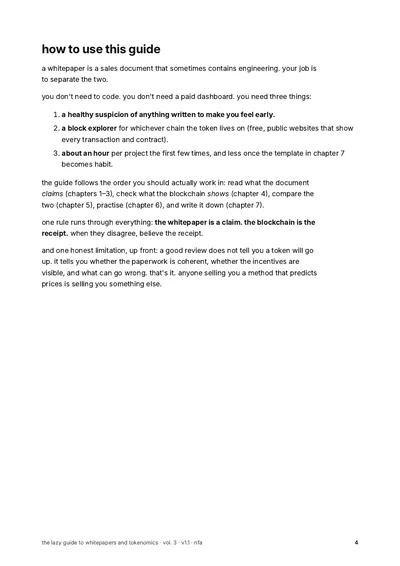
p. 4 · how to use this guide 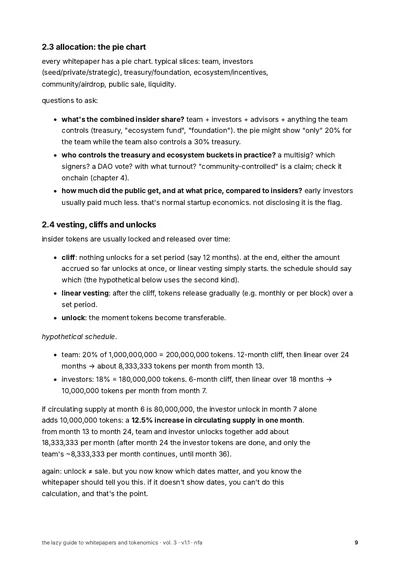
p. 9 · allocation: the pie chart 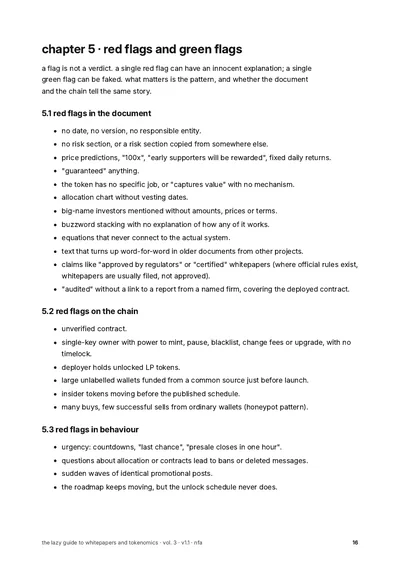
p. 16 · red flags and green flags 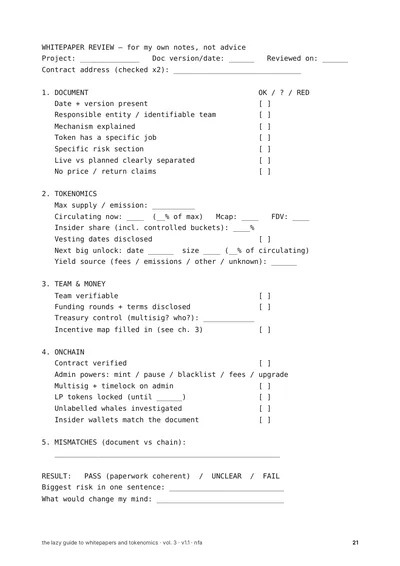
p. 21 · the one-page review template
what you learn
- the eight questions a useful whitepaper should answer, and a reading order that skips the marketing.
- tokenomics with light arithmetic: circulating, total and max supply, market cap vs FDV, vesting, cliffs and unlocks.
- where advertised yield comes from, and why high yield paid in new tokens isn't income.
- who gets paid: team, investors, market makers and promoters.
- basic onchain checks without connecting a wallet: is the contract verified, who has admin powers, who holds the tokens, who controls the liquidity.
- red flags and green flags, and why a mismatch between the document and the chain matters most.
- a full practice run on a made-up project, and a one-page review template you can reuse.
what's inside
- what a whitepaper should actually contain
- tokenomics without the hypnosis
- team, funding and incentives
- onchain data for beginners
- red flags and green flags
- practice run: a fictional whitepaper, start to finish
- your one-page review template
seven chapters, a practice run on a fictional whitepaper, a reusable review template, a glossary and primary sources.
who it's for
- you want to judge a project yourself instead of following someone loud.
- you've seen a pie chart of "tokenomics" and weren't sure what to look for.
- you're fine with checklists and a little arithmetic.
who it's not for
- you want signals, price targets or "coins to watch".
- you want someone to tell you what to buy. a passed review is not a reason to buy.
get the pdf
not on sale yet. nothing can be bought right now.
$3.99 one-time · pdf · no account
creating invoice…
in the x app? "open in wallet" may do nothing: tap copy invoice and paste it in your wallet, or open this page in your browser. expires in 15:00.
keep this page open. the download appears here when paid. receipt: bookmark this link.
paid. thanks. link valid 24h.
re-download for 12 months: your receipt page (bookmark it).
invoice timed out. if you didn't pay, nothing was charged.
paid it anyway? your receipt page still checks and delivers.
price $3.99. lightning: sold by the seller shown here when checkout opens. broken, missing or not what the page described: a working file or your money back. contact: rektnotrich@tuta.io. this doesn't limit your rights where you live.
no account, no cookies at checkout. we keep the order id, course and the ref/utm tag of the link you came from, nothing else. privacy.
questions
do i need to know how to code?
no. explorers show what you need without code. the guide says what to look for.
does it analyse real projects?
no. every project in the guide is made up. no real project is analysed or accused of anything.
will it tell me which tokens will go up?
no. a good review tells you whether the paperwork makes sense and what can go wrong. it can't predict prices.
can i read some of it first?
yes. chapter 1 is free at /c, as a direct download.
how much is it?
$3.99, one time, for one pdf. no subscription. each guide is sold on its own.
how do i pay?
with bitcoin lightning only. any lightning wallet that can pay a standard lightning invoice works. the invoice appears right on the page, no account needed. card, apple pay and on-chain bitcoin are not offered right now.
why does the invoice expire?
the price in sats moves with the bitcoin price, so each invoice holds it for 15 minutes. after that, make a new one with one click. if you didn't pay, nothing is charged.
when do i get the pdf?
right after the payment goes through, a download button appears on the same page. the link works for 24 hours. your receipt page lets you download again later. bookmark it.
do i need an account or an email?
no account, no email needed. your receipt page is your confirmation; save the receipt pdf.
what is the checkbox for?
the pdf is delivered right away. where you have a right to cancel a purchase, it ends once the download starts. the box asks you to confirm that. it is never ticked for you.
"open in wallet" does nothing.
that happens in some in-app browsers, like the x app. tap "copy invoice" and paste it into your wallet, or open the page in your normal browser.
who is the seller?
the seller's name and contact are shown in the checkout before you pay.
what if the file is broken?
broken, missing or not what the page described: a working file or your money back. contact: rektnotrich@tuta.io. this doesn't limit your rights where you live.
what do you keep about me?
the order id, which guide, and the tag of the link you came from. no account, no cookies at checkout. → /privacy/
is this financial advice?
no. it's education. nothing in the guides tells you what to buy, sell or hold.
words used in this guide
- whitepaper
- a document in which a project explains what it is building, how it works and how its token is meant to work.
more
the bitcoin paper (2008) was nine pages about a technical mechanism. many modern whitepapers are partly marketing: the paper is a claim, and the blockchain shows what actually happened. - tokenomics
- how a token's supply is created, shared out and released over time, and what the token is used for.
more
it covers supply numbers, who gets which share, vesting dates and the token's job. good technology can still come with a token that is a bad deal for late buyers. - circulating supply
- the tokens that can be traded on the market right now.
more
data sites count it slightly differently, for example in how they treat treasury or locked tokens, so check their method. - max supply
- the most tokens that can ever exist, if there is a cap at all.
more
some tokens have no cap. then what matters is how fast new tokens are created and who receives them. - market cap
- price × circulating supply.
more
it only counts the tokens trading today. it can look small while most of the supply is still locked. - FDV (fully diluted valuation)
- commonly price × max supply, or price × total supply if there is no max.
more
data sites differ: some use max supply, some use total supply, and some show no FDV for tokens without a max. a big gap between FDV and market cap means a lot of supply is still to come. - vesting
- releasing locked tokens gradually over a set schedule, often for the team and early investors.
more
a good whitepaper gives dates, length and frequency. "subject to vesting" with no dates tells you very little. - cliff
- a waiting period before any vested tokens unlock.
more
when it ends, either everything accrued so far unlocks at once, or gradual release begins. the schedule should say which. - unlock
- the moment locked tokens become free to move and sell.
more
an unlock is not a sale: recipients may hold. but large unlocks compared with circulating supply are dates worth knowing. - block explorer
- a free public website that shows the transactions, addresses and contracts on a blockchain.
more
you can check holders, contracts and transfers without connecting a wallet. a site that asks you to connect a wallet just to "check" something is a red flag. - verified contract
- a contract whose source code is published on the block explorer and matches what is actually deployed.
more
verified means you can read what it does, not that the code is safe or honest. for an upgradeable contract, check that the code it points to is verified too, and remember that code can be swapped later.
other topics
nfa. education, not advice. not personal advice.
education, not financial, investment, tax or legal advice. no recommendation to buy, sell or hold any crypto-asset. examples are made up or hypothetical. you can lose everything you put into crypto.