 b9_1155
ad · our own product · the lazy guides, vol. 5
the lazy guide to risk management
decide the loss before the trade, not after.
this guide won't help anyone find a better trade. it's about the other half: how much is lost when a trade is wrong, and how to keep that small enough to survive being wrong many times in a row. the maths is one division and a few multiplications. every number is made up, labelled and can be checked with a calculator.
hover or tap to flip
free reading first
not sure yet? these are free and use the same method.
-
position sizing for people who hate math
one rule, one division, and why it decides whether you survive a losing streak. hypothetical numbers only.
look inside
real pages from the pdf, as they are. page numbers refer to the full guide.
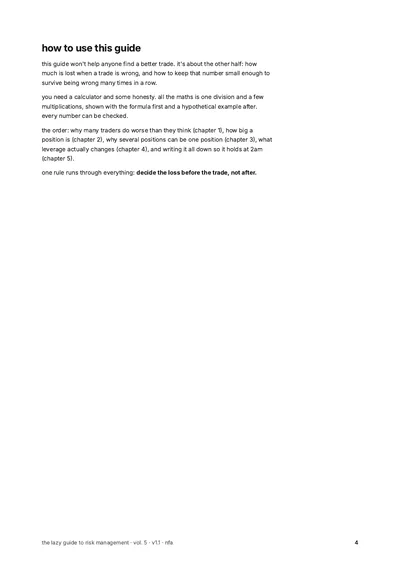
p. 4 · how to use this guide 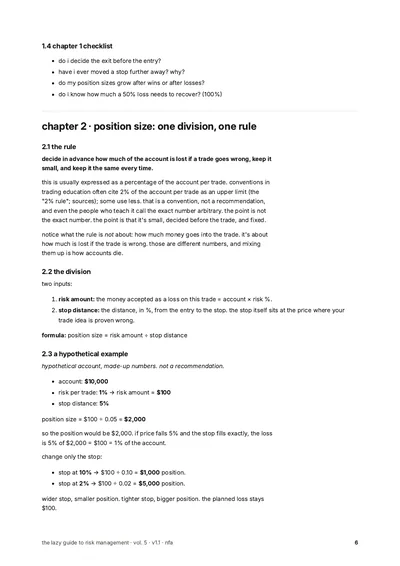
p. 6 · position size: one division, one rule 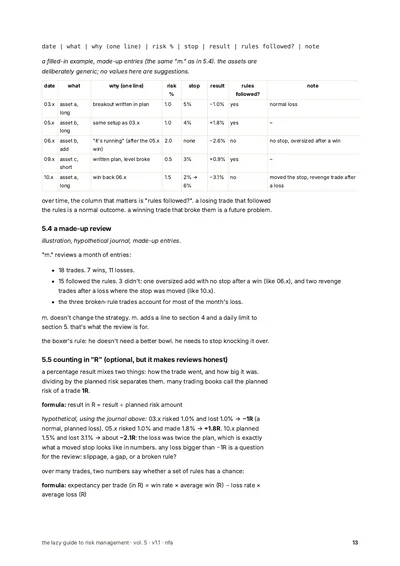
p. 13 · a made-up journal review 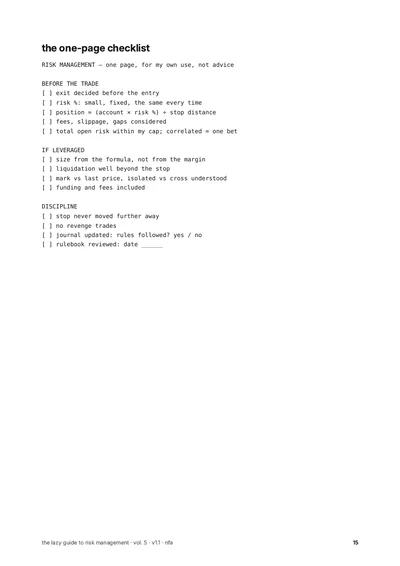
p. 15 · the one-page checklist
what you learn
- why losses and gains aren't symmetrical: a 50% loss needs a 100% gain to get back.
- position sizing in one division: position size = risk amount ÷ stop distance.
- why a stop-loss is a request, not a promise: fees, slippage, price gaps, and stop-market vs stop-limit orders.
- correlation: why five positions can really be one bet, and how to measure it yourself in a spreadsheet (on daily returns, not prices).
- what leverage actually changes: margin, liquidation before your stop, mark price, isolated vs cross margin, funding costs.
- how to write your own rulebook, keep a simple trade journal, and read it in units of risk (R) and expectancy.
heads-up: which leveraged products are offered, and with what limits, depends on where you live. laws differ by country. check the rules where you live.
what's inside
- why many traders do worse than they think (behaviour, not the market)
- position size: one division, one rule
- correlation: five bets that are one bet
- leverage, explained as a risk, not a method
- write your own rulebook (template)
five chapters, a rulebook template, a filled-in journal example, a do-it-yourself correlation check, a one-page checklist, a glossary and sources.
who it's for
- you've had a trade that hurt more than it should have.
- you want simple arithmetic instead of indicators.
- you want to write your own rules, not borrow someone else's.
who it's not for
- you want signals, entries or targets. there are none.
- you're looking for a reason to use more leverage.
- you want a promise of profit. a rulebook only limits how much is lost while you find out. not trading is also a valid choice.
get the pdf
ad · our own product. $3.99, one time. tick the box, then pay with bitcoin lightning. the download appears on this page as soon as the payment goes through.
$3.99 one-time · pdf · no account
creating invoice…
in the x app? "open in wallet" may do nothing: tap copy invoice and paste it in your wallet, or open this page in your browser. expires in 15:00.
keep this page open. the download appears here when paid. receipt: bookmark this link.
paid. thanks. link valid 24h.
re-download for 12 months: your receipt page (bookmark it).
invoice timed out. if you didn't pay, nothing was charged.
paid it anyway? your receipt page still checks and delivers.
price $3.99. lightning: sold by the seller shown here when checkout opens. broken, missing or not what the page described: a working file or your money back. contact: rektnotrich@tuta.io. this doesn't limit your rights where you live.
no account, no cookies at checkout. we keep the order id, course and the ref/utm tag of the link you came from, nothing else. privacy.
questions
does it tell me what or when to trade?
no. no signals, entries, price targets or assets to buy or sell.
does it recommend a risk percentage?
it mentions the conventions in trading education, which often cite 2% of the account per trade as an upper limit; some use less. that's a convention, not a recommendation. the blanks in the template are yours to fill in.
how much maths is there?
one division and a few multiplications. the formula comes first, then a made-up example.
is it only about crypto?
the examples are crypto trades. the evidence on trader behaviour comes from stock markets, and the guide says so.
how much is it?
$3.99, one time, for one pdf. no subscription. each guide is sold on its own.
how do i pay?
with bitcoin lightning only. any lightning wallet that can pay a standard lightning invoice works. the invoice appears right on the page, no account needed. card, apple pay and on-chain bitcoin are not offered right now.
why does the invoice expire?
the price in sats moves with the bitcoin price, so each invoice holds it for 15 minutes. after that, make a new one with one click. if you didn't pay, nothing is charged.
when do i get the pdf?
right after the payment goes through, a download button appears on the same page. the link works for 24 hours. your receipt page lets you download again later. bookmark it.
do i need an account or an email?
no account, no email needed. your receipt page is your confirmation; save the receipt pdf.
what is the checkbox for?
the pdf is delivered right away. where you have a right to cancel a purchase, it ends once the download starts. the box asks you to confirm that. it is never ticked for you.
"open in wallet" does nothing.
that happens in some in-app browsers, like the x app. tap "copy invoice" and paste it into your wallet, or open the page in your normal browser.
who is the seller?
rektnotrich (contact: rektnotrich@tuta.io). the same seller line is shown in the checkout before you pay and on your receipt.
what if the file is broken?
broken, missing or not what the page described: a working file or your money back. contact: rektnotrich@tuta.io. this doesn't limit your rights where you live.
what do you keep about me?
the order id, which guide, and the tag of the link you came from. no account, no cookies at checkout. → /privacy/
is this financial advice?
no. it's education. nothing in the guides tells you what to buy, sell or hold.
words used in this guide
- position sizing
- deciding how big a trade is, based on how much you are willing to lose if it's wrong.
more
a common formula is position size = risk amount ÷ stop distance. hypothetical: $100 at risk with a 5% stop gives a $2,000 position. - risk amount
- the money you are willing to lose on one trade if the stop fills as planned (account × risk %).
more
a common convention in trading education is 0.5–1% of the account per trade. that is a convention, not a recommendation. - stop-loss (stop)
- a planned exit price where a losing trade is closed.
more
it is usually placed as a stop order. it is a request, not a promise: in fast markets the fill can be worse than planned, or not happen at all. - stop distance
- the distance, in %, from the entry price to the stop.
more
a wider stop means a smaller position for the same risk amount; a tighter stop means a bigger one. - slippage
- the difference between the price you expected and the price you actually got.
more
it grows in fast or thin markets and makes real losses bigger than the planned ones. - leverage
- controlling a position larger than the money you put up (the margin).
more
hypothetical: with 5x, $400 of margin controls a $2,000 position. it does not change what a planned stop loses as long as the stop is hit before liquidation, but it makes oversizing easy, and fees and funding still eat into the margin. - margin
- the money posted to open and hold a leveraged position.
more
fees and funding payments can reduce it over time. when it runs too low, the position gets liquidated. - liquidation
- the exchange force-closing a leveraged position when its margin falls below the required minimum.
more
with high leverage it can happen before the stop is reached. with some products and in fast markets, losses can even exceed the money put in. - mark price
- a "fair" price, mostly based on an index of spot prices, that many exchanges use to trigger liquidations.
more
stop orders often trigger on the last traded price instead. the two can differ briefly, so a position can be liquidated before its stop fires. - correlation
- how much two things tend to move together, from −1 (move in opposite directions) to +1 (move perfectly in step).
more
it changes over time and often rises when markets fall. five positions that move together can act like one big bet.
other topics

nfa. education, not advice. not personal advice.
education, not financial, investment, tax or legal advice. no recommendation to buy, sell or hold any crypto-asset. examples are made up or hypothetical. you can lose everything you put into crypto.